SANSOR's role in seed certification
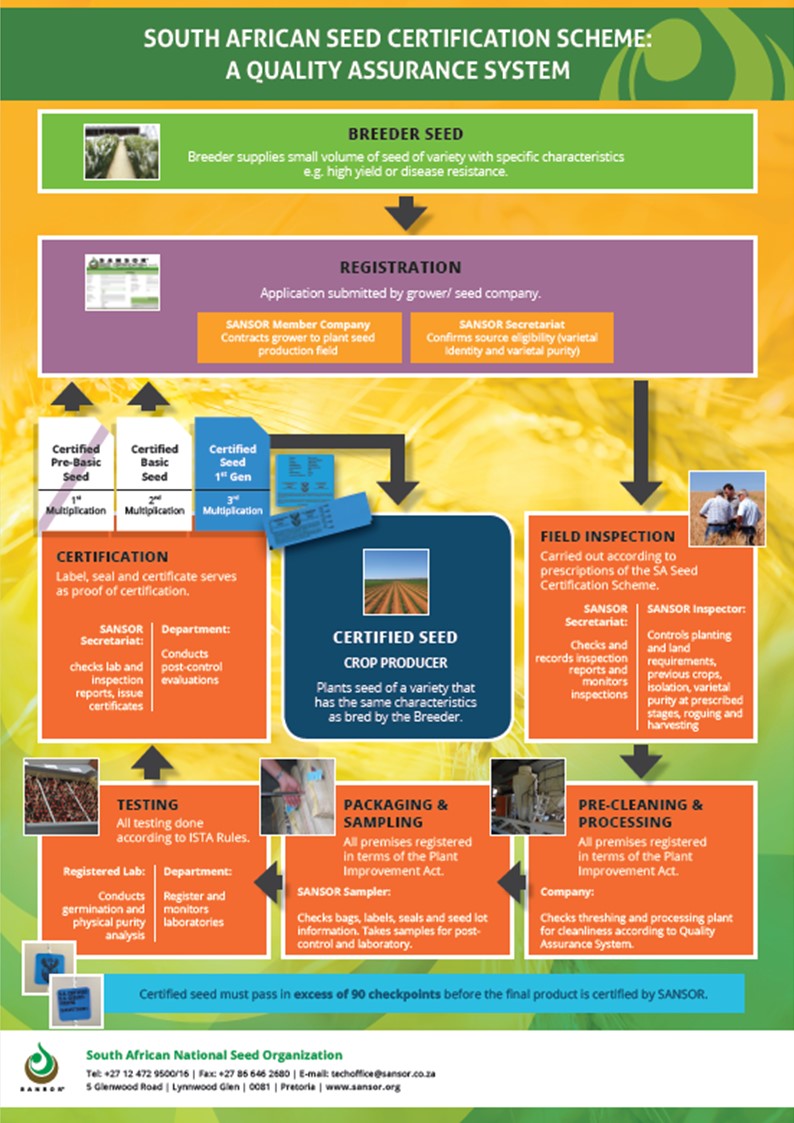
The fact that seed is sold by a registered business and / or an analysis report is available does not mean that that seed lot is certified. Certification of seed involves a complete control system from the release of the variety by the breeder thereof up to the eventual release of the seed to the producer. It occurs over several generations of propagation which usually takes up to three or four seasons.
During each of the various multiplication processes, complete control is performed, whereby each seed production unit is registered with SANSOR. SANSOR first checks the origin and certifiability of the parent seed of the variety concerned before the unit is accepted for seed production for certification. Plants are inspected by SANSOR trained and authorized inspectors at specific growth stages to determine, among other things, that the plants comply with the prescribed minimum requirements for varietal purity and identity. This includes aspects such as controlling isolation distances, previous cropping, volunteer plants, off-types, etc. which may compromise the varietal purity of the seed. For each inspection performed, a report is submitted to SANSOR which then records the finding. The inspection process is continuously monitored by SANSOR, as well as by officials of the Department of Agriculture, Land Reform and Rural Development (DALRRD).
After the seed is harvested, it is processed and packaged. Again, there is total control to ensure that no mixing or contamination occurs. The containers in which the seed is packed are then labeled with prescribed information on labels provided by SANSOR. Seed certification is voluntary in South Africa except for a select few varieties.